






Welcoming a new child into your family through adoption is a beautiful, life-changing journey. However, it’s no secret that the adoption process can also be incredibly expensive. Between agency fees, legal costs, and travel, the financial hurdles can sometimes feel overwhelming.
Fortunately, the federal government offers a powerful financial safety net to help families offset these costs: the Adoption Tax Credit. Because tax rules can look like a completely different language, let’s break down exactly how this credit works, who qualifies, and how it can help put thousands of dollars back in your pocket.
What is the Adoption Tax Credit?
The Adoption Tax Credit is a federal tax benefit designed to help families recover some of the money spent during the adoption process. It is important to know that this is a tax credit, not a tax deduction.
Credit vs. Deduction: Why Credits Are Better
A tax deduction simply reduces the amount of income you are taxed on. A tax credit is a dollar-for-dollar reduction of your actual tax bill. If you owe $5,000 in federal taxes and qualify for a $4,000 tax credit, your tax bill drops directly to $1,000.
How Much is the Credit Worth?
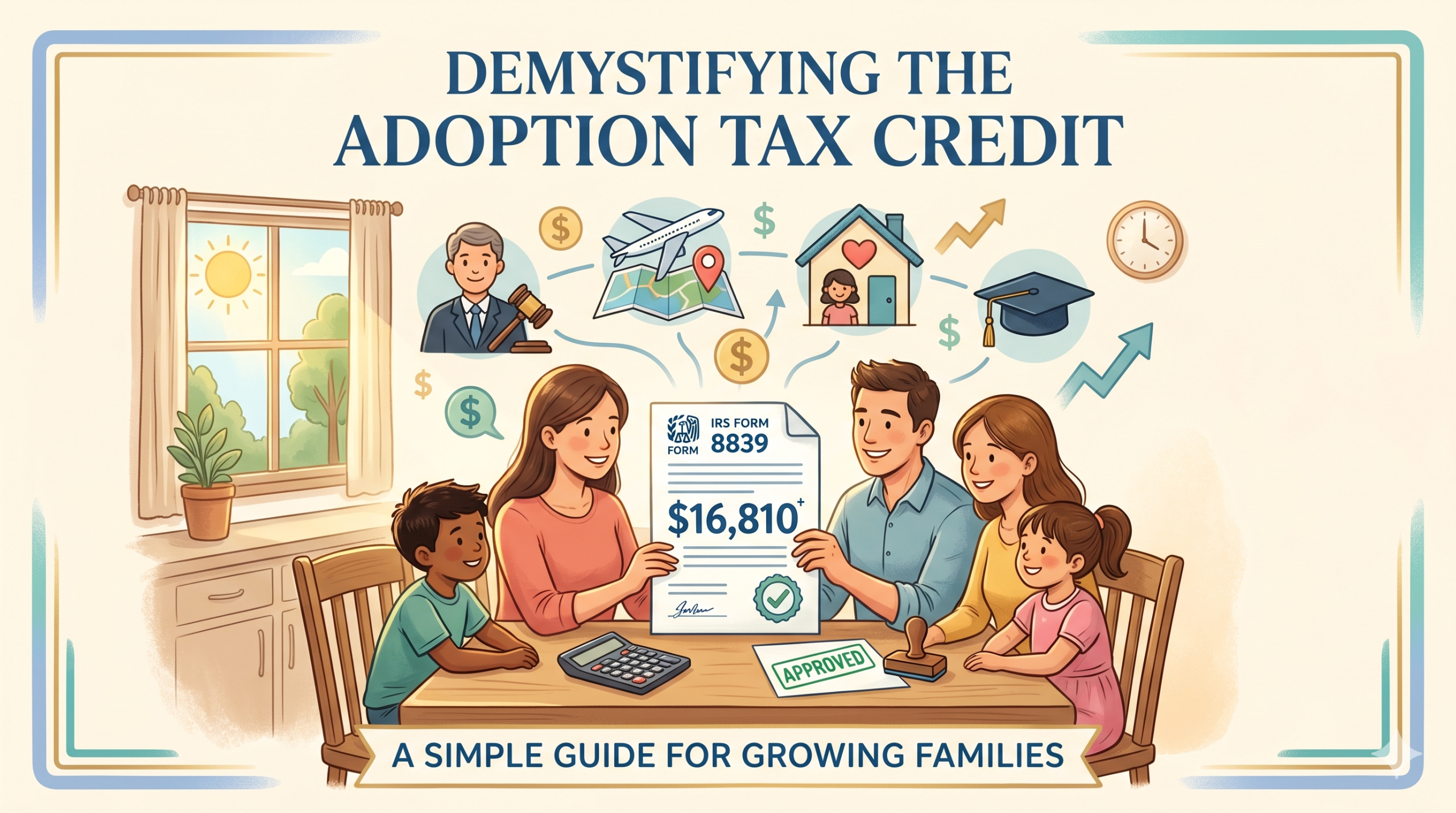
The maximum credit amount changes slightly each year to keep up with inflation. For recent tax years, the credit is worth up to $17,280 for 2025, up from $16,810 in 2024. If you adopt two children, you can potentially claim up to twice that amount.
The final amount you receive depends on two main things: how much you actually spent on the adoption, and your household income.
What Expenses Qualify?
You can claim the credit for “reasonable and necessary” expenses directly related to the legal adoption of an eligible child. These typically include:
- Agency Fees: Fees paid to public or private adoption agencies.
- Court Costs & Legal Fees: Attorney fees, court filing fees, and legal documentation costs.
- Travel Expenses: Meals, lodging, and transportation (like plane tickets or gas) while away from home to complete the adoption.
- Re-adoption Expenses: Costs to legally finalize a foreign adoption in your home state.
Who is an “Eligible Child”?
To qualify for the credit, the child you are adopting must fit into one of these categories:
- Under the age of 18 when the adoption takes place.
- Physically or mentally incapable of caring for themselves, regardless of age.
Note: You cannot claim the Adoption Tax Credit if you are adopting your spouse’s child (such as a stepparent adoption).
The “Special Needs” Rule: A Crucial Exception
If you adopt a child from the foster care system who is designated by the state as “special needs,” a very generous exception applies. In the eyes of the tax code, “special needs” usually means the state has determined the child cannot or should not return to their birth parents’ home, and that factors like age, ethnic background, or medical conditions mean the child requires assistance to be adopted.
If your child meets this official definition, you are automatically eligible to claim the maximum credit amount, even if your actual out-of-pocket adoption expenses were zero or minimal.
Income Limits (The Fine Print)
The credit is designed to help low- and middle-income families. Because of this, it phases out if you make over a certain amount of money. The income thresholds adjust annually, but generally follow this structure:
| Your Modified Adjusted Gross Income (MAGI) – For 2025 | How it Affects Your Credit |
| Below $259,190 | You get the full credit (up to the maximum limit). |
| Between $259,191 and $299,189 | You get a partial credit (it gradually phases out). |
| Above $299,190 | You do not qualify for the credit. |
Is the Credit Refundable?
Currently, the Adoption Tax Credit is non-refundable. This means it can only reduce your tax liability to zero. If your total tax liability for the year is smaller than your credit, you won’t get the leftover balance as a cash refund check.
The Good News: You don’t lose that leftover credit! The IRS allows you to carry forward any unused credit for up to 5 additional years. So, if you can’t use the whole credit this year, it can help lower your taxes next year, and the year after that.
When Do You Claim It?
The timing depends on the type of adoption. It can get slightly confusing, but here is a simple breakdown of when to file IRS Form 8839 (the form used to claim the credit):
- Domestic Adoptions (U.S.): You can actually claim expenses the year before the adoption is finalized. If the adoption falls through, you can still claim those expenses in the year they occurred.
- International Adoptions: You must wait until the year the adoption is officially finalized to claim any and all expenses.
Keep Every Receipt!
The absolute best thing you can do during your adoption journey is to keep meticulous records. Create a digital folder or a physical binder for every agency statement, court receipt, and airline ticket. When tax season rolls around, having these organized will make claiming your credit smooth and stress-free.
Disclaimer: While this guide simplifies the basics, tax laws can change and individual situations vary. It is always a great idea to consult with a qualified tax professional or a certified public accountant (CPA) who has experience with adoption tax benefits when you are ready to file.